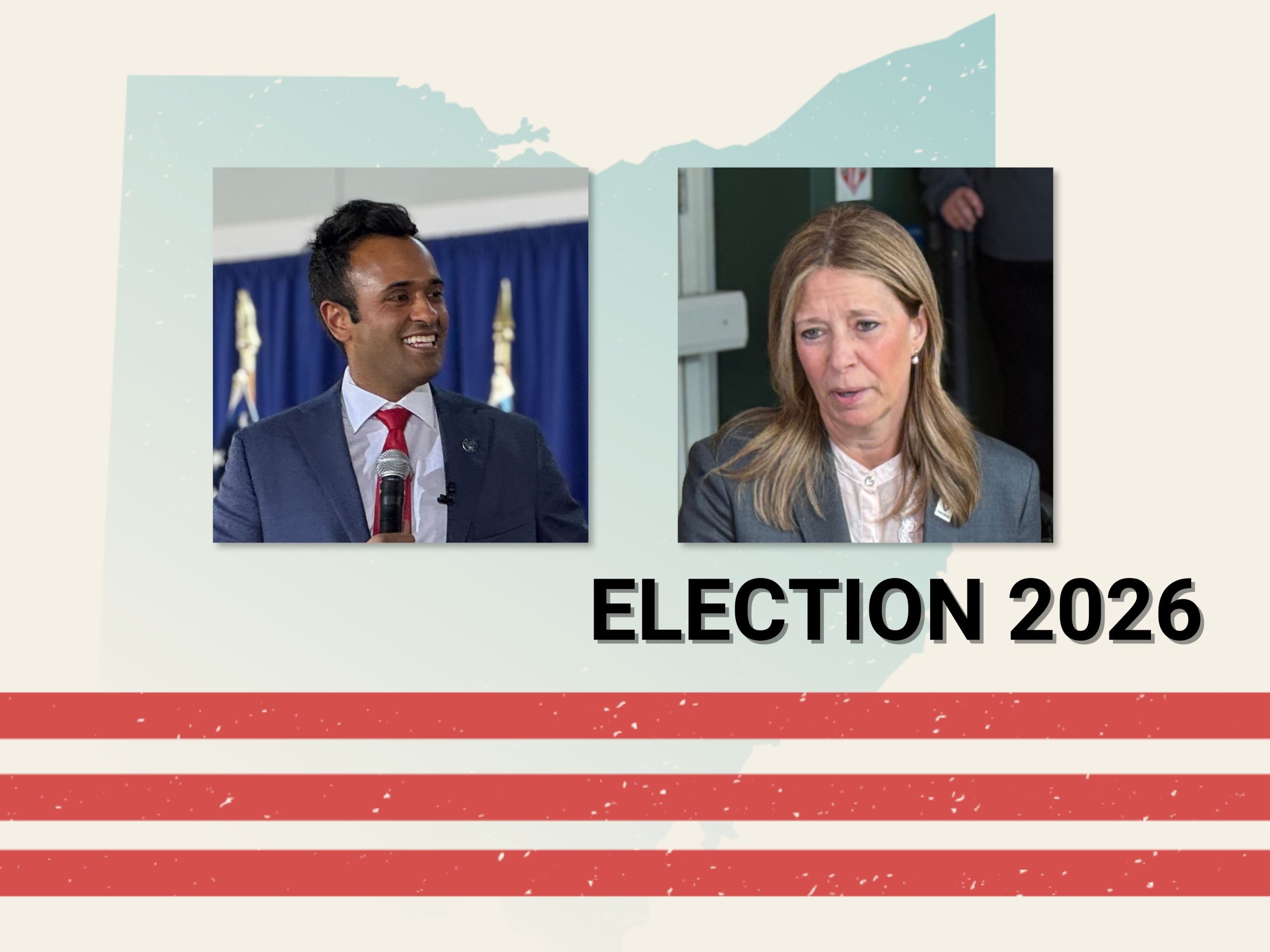
Big money is starting to flow into Ohio’s 2026 elections – and it’s coming from some notable places.
A cryptocurrency-backed group announced this week that it plans to spend $8 million opposing Sherrod Brown in Ohio’s U.S. Senate election in November. Brown, a former Democratic senator, is challenging Republican Sen. Jon Husted, whom Gov. Mike DeWine appointed to his seat last year. The spending comes after millions in cryptocurrency industry money helped contribute to Brown’s Senate ouster in November 2024 – and could foreshadow more to come later this year.
Meanwhile, one group backed by the sports betting industry has spent about $1 million on state legislative races so far this year. Another has given $650,000 to a super PAC, a political action committee that can accept unlimited amounts of money, that’s backing Republican Vivek Ramaswamy in this year’s governor’s race.
A new federal disclosure from that PAC also reveals new contributions from an Ohio charter school operator and a billionaire school choice backer who has now given the group $20 million.
New federal campaign finance disclosures detail the spending and reveal which races have attracted interest group money in Ohio’s 2026 elections.
Following the 2026 Ohio election?: See all of our coverage of the races, the issues and the information you need to know to vote.
The U.S. Senate race
The Sentinel Action Fund announced Wednesday that it plans to spend $8 million this year opposing Brown. The political action committee’s financial backers include a pair of major cryptocurrency interests:
- The Solana Policy Institute, a nonprofit arm of Solana, a cryptocurrency platform, which has given $740,000
- Multicoin Capital, an Austin-based crypto-focused venture capital firm, which gave $250,000 last year
Sentinel Action Fund’s backers include non-crypto money, according to filings the group made Wednesday and last year with the Federal Election Commission shows, including:
- $1.125 million from the DeVos family, Republican megadonors based in Michigan
- $1 million from the Lexington Fund, a political nonprofit tied to Republican activist Leonard Leo
- $500,000 from Stephen Schwarzman, the co-founder and CEO of Blackstone, one of the world’s largest private equity firms
- $400,000 from RAI Services Company, an affiliate of the Reynolds tobacco company
- $350,000 from Altria, Philip Morris’ parent company and another major tobacco corporation
Brown leads Husted in fundraising as Republicans target U.S. Senate race
The $8 million follows the $79 million Senate Republicans separately announced they planned to spend in Ohio this year.
That’s the most they’re planning to spend in any of the eight battleground Senate races as Republicans try to keep their majority in the chamber. Democrats face an uphill climb that could be getting more feasible as the national mood sours against Republicans.
On Wednesday, Brown and Husted also disclosed their campaign finance activity during the first four months of this year.
Brown raised $10.1 million and has $16.5 million in cash in his bank account after spending $3.5 million in the first quarter of 2026.
Husted raised $2.9 million and has $8.2 million in cash after spending $627,000.
Individual donations to candidate campaigns are capped by law, unlike the unlimited contributions that flow to super PACs like Sentinel.
But Brown’s major contributors included labor unions, like the Ironworkers and the United Food & Commercial Workers, both of which gave $10,000.
Brown also disclosed receiving $33,400 in contributions bundled by JStreet PAC, a left-leaning pro-Israel lobbying group.
Husted’s large donors included Jan Koum, the co-founder of WhatsApp, and Frank Love and Greg Love, the family that owns Love’s Travel Stops. He also collected tens of thousands of dollars in corporate PAC contributions, including from a variety of Ohio companies: American Electric Power, Cardinal Health, Goodyear, J.M. Smucker, NiSource, NetJets, Eaton and Anduril, a military contractor that’s building a giant factory in the Columbus area.
In all, Ohio’s Senate race this year is looking increasingly like a repeat of the historically expensive 2024 election, in which Republican Sen. Bernie Moreno defeated Brown 50% to 47%.
In that race, Republicans and Democrats spent nearly $250 million total, with the number roughly split until late-arriving money from the cryptocurrency industry tilted the balance in Moreno’s favor. The industry has signaled it may spend big again to defeat Brown this year.
Brown, at the time, was chair of the powerful Senate banking committee and was seen by the industry as an adversary. His campaign manager, Patrick Eisenhauer, has issued a more conciliatory statement for this current election.
“Sherrod Brown recognizes that cryptocurrency is a part of America’s economy,” Eisenhauer said. “He’ll keep an open mind towards all issues as they come before the Senate, and work to ensure that as more people use cryptocurrency, it expands opportunity and lifts up Ohioans.”
Sports betting
As previously reported by cleveland.com, a group called the American Conservative Fund, which has ties to the sports betting company Draft Kings, has spent roughly $1 million on ads in five contested Ohio House Republican primary races so far this year.
That money is being spent on three open races and against incumbents in two races, according to Medium Buying, a political ad firm in Columbus. One of those incumbents, state Rep. Gary Click, introduced a bill earlier this month that would ban Ohioans from using their mobile devices to bet on sports.
Another political group backed by the sports betting industry showed up Wednesday in a campaign finance disclosure filed by V-PAC: Victors not Victims, the super PAC formed by Ramaswamy’s allies to support his run for governor.
The Sports Betting Alliance, an industry trade group, gave $150,000 to VPAC in January, adding to the $500,000 it gave the PAC last year.
The spending comes as Ohio transitions to new leadership in the governor’s office.
Outgoing Gov. Mike DeWine, who is term-limited, signed the 2021 law legalizing sports betting in Ohio. But he later said doing so was his biggest regret of his time in office. He’s pushed for restrictions on sports betting, like banning prop bets on college sports and pushed for greater limits on “micro-prop” bets for baseball following a gambling scandal involving two Cleveland Guardians pitchers.
Neither Ramaswamy or his likely opponent in the November election, Democratic frontrunner Dr. Amy Acton, have shared a public position on sports betting.
In a statement provided for this story, Acton campaign spokesperson Addie Bullock said Acton “believes that Ohioans should decide how to spend their hard earned money, whether that’s at the grocery store or betting on their favorite team.”
A Ramaswamy spokesperson didn’t return a message.
School choice backers
V-PAC’s largest contributor was Jeffrey Yass, a Pennsylvania billionaire. He gave the group $10 million, according to the new filing, doubling the $10 million contribution he gave to VPAC last year. Yass is also one of the largest donors to school choice causes in the country, having given hundreds of millions of dollars to school voucher and charter school advocacy over the years.
Ramaswamy received a contribution from another donor in the school choice world – Pansophic Learning gave $25,000. A company subsidiary, Accel Schools, operates a large network of online and in-person charter schools in Ohio.
Ramaswamy has made expanding school choice one of the pillars of his campaign platform for governor. He’s also suggested he might seek to dismantle Ohio’s public school teachers’ unions, while raising teacher salaries and instituting merit-based pay.
Acton, meanwhile, has pledged to increase funding for traditional public schools and is endorsed by large teachers’ unions.
Ramaswamy expands cash lead
In total, V-PAC reported raising nearly $11 million in its most recent fundraising period, giving it a total of $23 million in cash.
The super PAC’s new money adds to Ramaswamy’s historic fundraising lead in the race.
Ramaswamy has raised $19.4 million in total for his campaign, and reported having $12.9 million in cash in a state filing in January.
Acton has reported raising $5.3 million overall and reported $3 million in cash in January.
Both Ramaswamy and Acton are due to make an updated state disclosure later this month. The filing will be the last one before the May 5 primary election.