


Three companies voluntarily agreed to halt their injections of millions of gallons of liquid waste into the Southeast Ohio earth at the “request” of the Ohio Department of Natural Resources, the agency said.
The four Washington County injection wells at issue have been “suspected to be causing impacts” to nearby oil and gas wells, according to department spokesperson Andy Chow.
Chow said ODNR has been inspecting all oil wells within a two-mile radius of the four injection wells since October 2025, finding fluid and increased pressure that indicate a brine migration problem with the injection wells.
He said ODNR is in the early stages of a study to monitor private water wells in the impacted areas. He noted most water sources sit at a much shallower depth than the injection zones.
The ODNR has legal power to issue suspension orders of injection wells for a variety of reasons, including when it can demonstrate that brine has leaked beyond the allowed injection zone underground or is endangering the public.
ODNR said this “was not necessary as the injection well owners have
voluntarily shut down the class II disposal injection wells in response to
the Division’s concerns.”
Chow said ODNR drafted suspension orders in June but backed off when the companies agreed to halt their operations voluntarily. The department has since installed devices that can continuously measure pressure at nearby wells during the shutdown.
It’s unclear when and under what conditions the operators can resume pumping millions of gallons of brine into rock formations underfoot.
The suspensions, enacted July 1 and July 2 by the operators, follow community outcry from a range of interests.
Water officials in nine Washington County authorities jointly warned in a recent letter that the 502 million gallons of liquid waste pumped into the county’s underground rock formations in just the past two years amounts to “too much waste, too close to our aquifers.” All nine have passed resolutions seeking a temporary moratorium on new injection wells and any ongoing operations near an aquifer.
Fracking a single well can require millions of gallons of water, which is pumped back to the surface afterward as a salty, toxic mixture of chemicals added by operators and natural, radioactive elements in the earth.
That brine has started showing up in oil wells near the injection wells, according to ODNR and several oil well owners in the area who have spoken out against the local wastewater injection industry, “flooding” them out and replacing all the oil with a nasty slurry.
If the wandering, high-pressure brine could find their oil wells, they and other critics say, then it can contaminate a drinking water source too.

History of brine leaks
Since 2020, the ODNR’s Division of Oil and Gas Resources has issued suspension orders against seven injection wells (not counting the four that were voluntarily suspended this month). There are 227 currently operational in Ohio.
Redbird Development owns two of the halted operations, which sit a few hundred yards apart.
This isn’t the first suspension for the Redbird #4 injection well. A state investigation found that in 2019, it showed evidence of a significant leak (technically known as “brine migration”) in its first month. It flooded 28 oil wells, some that were miles away, after taking 176 million gallons of injections, the investigation found.
After a hiatus, the state allowed Redbird to resume injections in 2020, only requiring injections into a different rock formation and depth at the same site.
“After division geologists analyzed the report and the best available information at the time, the division authorized Redbird No. 4 (June 2020) to once again operate but only at the deeper injection zone (Bass Island Formation) which has different geological properties,” Chow said.
Bob Wilson, who owns oil wells nearby that he says flooded with brine that Redbird injected, said his pressure readings began to creep up in 2023, which has accelerated in recent months.
Wilson and Bob Lane, another Washington County oil well operator, have filed a lawsuit against Deeprock, Redbird and several other injection well operators in the area over their flooded wells. The case is pending at the Ohio Supreme Court.
Redbird didn’t respond to inquiries sent to its lawyers. A phone number listed in ODNR records for the company was out of service.
It has argued in court filings that Wilson and Lane, who are suing it among others for allegedly causing the flooding in their oil wells, are trying to “vilify” the industry, which is “legal, legitimate and necessary to the multi-billion dollar oil and gas industry in Ohio.”
One suspended well linked to Ohio state senator
Another of the voluntarily suspended wells, American Growers #1, is owned by Deeprock Disposal Solutions, which has been previously penalized by regulators.
ODNR in 2023 shut down two Noble County injection wells owned by Deeprock – the Travis and Warren – which regulators say caused “uncontrollable” well blowouts and an “imminent health, safety, and environmental risk.”
Brine migration can cause well blowouts when the chemical cocktail – pumped underground into rock formations at extraordinarily high pressure thousands of feet below – escapes outward and flows into a vertical silo like an oil or water well. It springs from high pressure underground to lower pressure at the surface, using the bore hole like a straw, which can leave a nasty and hazardous mess.
ODNR’s suspension order attributes five instances between 2010 and 2023 where the Deeprock wells’ brine showed up in nearby oil wells. One “uncontrolled release” in 2021 sprayed uncontrollably for days, causing $1.3 million in mitigation later paid by the oil well owner.
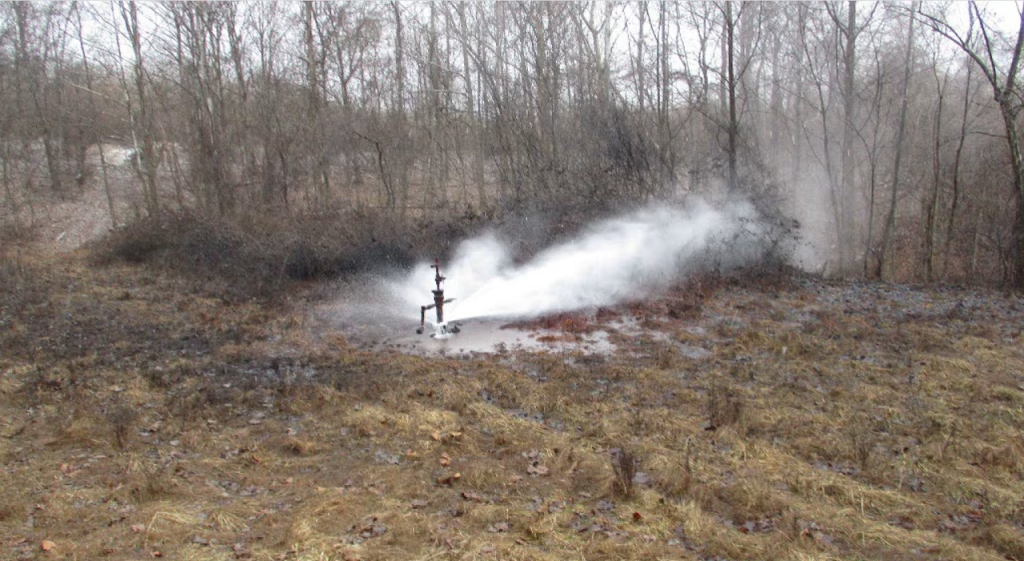
The last straw came in January 2023 when the division said inspectors saw brine spraying from the production casing of an oil well 5.4 miles away from the injection site, per ODNR records.
Laura Goins, a West Virginia attorney who represents Deeprock, said the company, based on its independent analyses, doesn’t believe brine is migrating underground.
She said ODNR’s data points to alternative explanations including “documented well integrity and compliance issues in all of the alleged impacted local [oil] wells” that merit further investigation.
“While we respect ODNR’s oversight and maintain a collaborative working relationship with the agency, our preliminary analysis shows no evidence of fluid migration from DeepRock’s operations into the affected formations,” she said.
“It’s important to note that the AG1 well is fully compliant with all state and federal requirements.”
The company is notable for a powerful political tie. Brian Chavez was CEO of Deeprock when he was appointed to the Ohio Senate in late 2023, representing Washington County among others. He resigned from the company in 2024, according to his financial statements filed with a state legislative ethics office. However, some have questioned the truthfulness of his independence, pointing to apparently ongoing involvement of his wife with the company, his disclosed ties to allegedly related entities, and a 2025 document filed in West Virginia that lists him as a manager.
Goins said Brian Chavez hasn’t been involved in management or operations at Deeprock since he resigned in 2024. She didn’t respond to questions about his wife’s role.
In court filings, Deeprock has denied Wilson’s allegations, calling them a “shotgun” approach that’s loosely aimed at “every” injection well operator in Washington County.
‘Negligence’
On Bob Wilson’s land, his oil wells indicated no pressure in 2020, according to his data, shared by Buckeye Environmental. However, it gradually climbed upward to around 50 psi in September 2023 and 310 psi in June 2026.
“The ODNR and the injection well industry have ruined my business. It’s wrong,” he said in a statement at the time.
The voluntary suspensions occurred after Wilson and Buckeye Environmental distributed their findings of the pressure readings, but before a press conference scheduled for July 7.
Bev Reed, an organizer with Buckeye Environmental, said in an interview Tuesday that while ODNR is doing the right thing now, it should have been cracking down years ago.
She said the department should, at minimum, stop the development of new injection operations in the county, ban injections that are too close to drinking aquifers, and study the pressure the industry is applying underground.
“This is negligence on the part of [ODNR], she said. “Despite well blowouts and migration incidents occurring in multiple southeastern counties of Ohio, including Washington, Nobel and Athens, to-date there has been no long-term, thorough, systemic analysis of the brine waste migration saga within Southeastern Ohio.”